Black widow spider
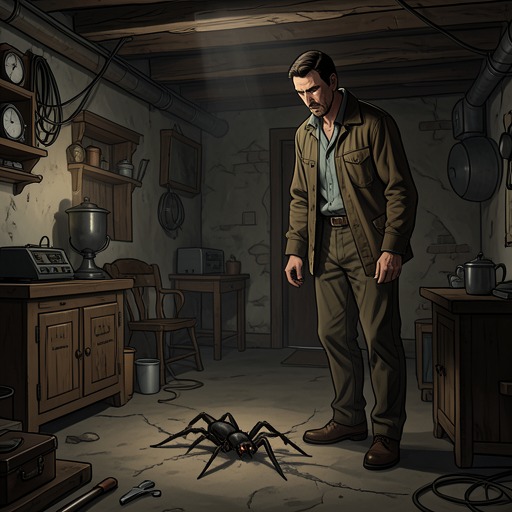
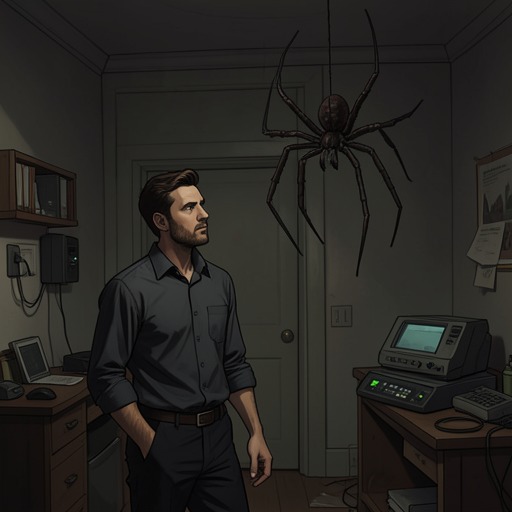
The Shrinking ManThe Black widow spider is the recurring predator in Scott Carey’s cellar ordeal: a creature whose scale and presence make ordinary space dangerous, yet whose eventual defeat marks a reversal in Scott’s capacity to survive. It first occupies his awareness as a threat beyond his control; later, Scott studies its movements, sets a trap, and confronts it directly. The progression from fear to action gives the spider significance beyond its immediate danger: it is both a physical antagonist and the test against which Scott discovers that he still has some power to act.
A recurring presence in the cellar
The spider enters Scott’s experience first as an uncertain sound. Feverish and weakened, he lies beneath the box top and thinks he hears it walking overhead. His mind turns the steps into a counting rhythm, with the spider’s seven legs woven into the fevered pattern. In this moment, the creature’s presence is not confirmed by sight; illness and fear make even a possible sound difficult to separate from Scott’s altered perception. The spider has become so central to his danger that it remains in his thoughts when he is barely conscious.
The threat becomes visible when the spider runs down the cellar wall. Scott has just confronted how little food and water remain and how unlikely he is to escape. The spider’s appearance interrupts that bleak calculation with a more immediate danger: he flees beneath the box top and climbs onto the sponge, while the spider reaches the box above him. Its presence then makes the food stored there inaccessible. The creature does not need to attack Scott directly to worsen his condition; by occupying the route to his remaining provisions, it constricts an already precarious existence.
Habits, shelter, and earlier resistance
Scott’s later search for the spider takes him away from the light of the window and into a darker part of the cellar. He expects a black widow to be reticent and to make its web in a secluded place; there, high on its web, he finds it beside the remains of a beetle. The setting makes its absence earlier in the day intelligible to him. It has not disappeared: it has been concealed in the kind of shadowed corner where Scott knows to look. The web also fixes their positions in the cellar, giving the spider a high, stationary refuge while Scott approaches on foot.
The spider is not a wholly new obstacle when Scott searches the carton. He recalls having fought it there before and recognizes, with surprise, that he was capable of resisting it. That earlier encounter belongs to a wider history of making tools and shelter from the carton’s contents: Scott had obtained thimbles, cloth for a robe, and thread from it. The spider’s place in this memory therefore connects it to the practical ingenuity Scott has already exercised. The earlier fight does not remove the danger, but it gives him evidence that the creature is not invulnerable and that his own actions can matter.
The final confrontation
When Scott finds the spider in its web, he has lost the pin that had helped him feel defended. He fears that the spider might come between him and the pit, and he proceeds cautiously as the light fades. These circumstances make the confrontation a problem of position as much as courage: Scott must draw the spider toward a place where he can use the ground and the objects around him to his advantage.
At the pit, Scott waits until the spider is close, then leaps aside. The spider’s forward movement carries it into the opening. Scott slides a piece of cardboard across the pit and holds it down as the spider struggles underneath. The cover does not settle the contest. It tilts, and Scott must continue defending himself rather than assume the trap has worked. He uses the pin as a spear and repeatedly strikes at the spider when it approaches. Once it has weakened, he chooses not to leave it to die on its own: he enters the confined space and makes a final deliberate attack. The spider falls still, and Scott collapses from exhaustion. When he wakes, he sees its motionless body and remembers that he must obtain the hook.
Narrative role and significance
The spider’s appearances establish a pattern of danger that first seems to reduce Scott’s choices. During fever, it is an uncertain sound; at the box, it blocks access to food; in the web, it becomes a visible adversary whose location Scott must discover. Each return changes the practical stakes without changing the basic imbalance in scale. The cellar’s ordinary objects and spaces—box top, sponge, web, pit, cardboard, pin—become part of a contest Scott cannot avoid.
The final encounter reverses the earlier arrangement. The spider once controlled access to Scott’s food and forced him to retreat. At the pit, Scott uses its movement against it, turning the terrain into a trap and following through when the first cover proves insufficient. His victory does not make the cellar safe or undo his weakness; he is left unconscious and must still attend to what comes next. But the spider’s death confirms a limited, hard-won change: Scott can observe a threat, plan around it, and act decisively. As a recurring predator, the Black widow spider makes that change visible through the difference between Scott’s first fearful retreats and his final, deliberate resistance.